
Kick Scooters vs. Stunt Scooters: Understanding the Differences

Kids love toys, and while they might enjoy playing with just about anything, it’s your responsibility as a parent to choose the right ones. This means selecting toys that not only bring joy but also contribute to their overall development and safety.
When it comes to outdoor play, scooters for children are an option that ticks all the boxes! In addition to being a fun way to get around, scooters offer several benefits. Riding a scooter requires children to balance on two or three wheels while propelling themselves forward with their legs. This activity helps improve their balance, core strength, coordination, and gross motor skills. It also boosts endurance, leg strength, and cardiovascular health, making it an excellent form of exercise.
To ensure your child gets the most out of their scooter, choosing the right type for their age and ability is essential. This often means deciding between a kick scooter and a stunt scooter. Let’s explore the differences to help you make the best choice.
Kick Scooter
A kick scooter is primarily used for recreational purposes. These scooters are not designed for performing tricks at the skatepark; instead, they are best suited for use at home, on the street, or in playgrounds.
Most kick scooters for children on the market are made from lightweight materials, making them easy to carry. Many models are foldable, adding to their convenience. They typically feature adjustable handlebars to accommodate different rider heights and generally have larger wheels made from softer materials to ensure a smoother ride over various surfaces. A rear-wheel braking system provides better control during rides, enhancing safety.
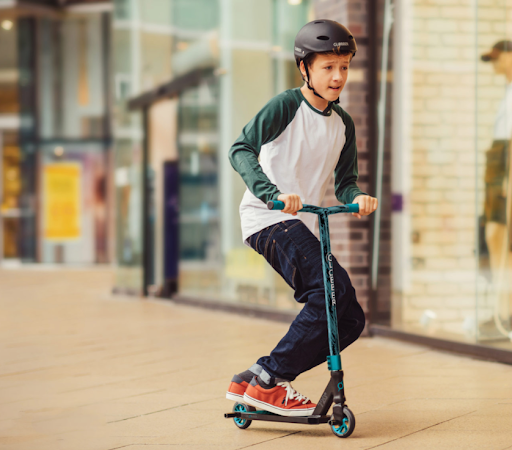
When choosing a kick scooter, you’ll have the option to choose between a two-wheel and a three-wheel scooter.
- Two-Wheel Scooters: These are often better for older children, typically those aged five and up. They require greater balance and coordination, which means they are more suitable for kids who have already developed these skills, such as those who can ride a bike without stabilisers. However, younger children might struggle with two key challenges: gaining and maintaining speed and constant steering. Your child must be strong enough to drive the two-wheeled scooter to the minimal speed required for balance, and to keep control, they must remain active and steer the handlebars continuously.
- Three-Wheel Scooters: These are more appropriate for younger children, generally those under the age of five. Three-wheel scooters provide a larger surface area for the feet and can stand upright without support, eliminating the need for balancing while riding. They often feature a lean-to-steer system, an intuitive approach that allows children to quickly learn the relationship between turn speed and their centre of mass. This system helps build confidence as children can recover easily if they lose balance.
Stunt Scooter
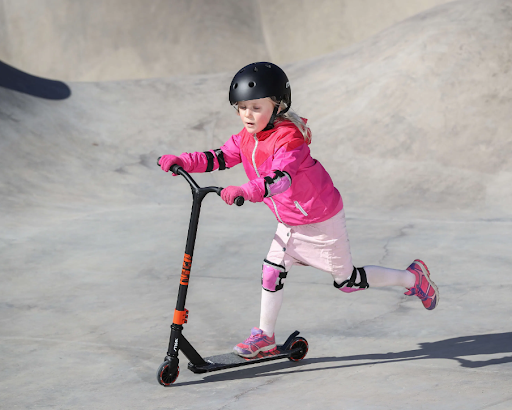
As the name suggests, a stunt scooter is designed for performing tricks and stunts, making it more robust and durable than a kick scooter. While it can be used for regular scooting on pavement, the ride will be less comfortable compared to a kick scooter. Stunt scooters are recommended for older kids who are interested in skateparks and extreme sports.
Stunt scooters feature fixed handlebars to withstand the impact of jumps and stunts. Unlike kick scooters, they do not have foldable or adjustable handlebars, as these could fail or collapse during a landing. Stunt scooters are typically constructed from more durable materials like aluminium and steel. These materials are extremely sturdy and can withstand the demands of stunts while remaining lightweight enough for easy manoeuvrability.

The decks of stunt scooters are wider than those of kick scooters to ensure better stability. A wider deck allows riders to lock into grinds and provides more area to land tricks, increasing control and enabling more sophisticated stunts.
To further enhance stability and speed, stunt scooters are equipped with larger wheels. The larger wheels offer better grip on surfaces, allowing for smoother and more controlled carving, as well as a more comfortable ride by absorbing more impact when landing tricks.
Stunt scooters come in a variety of sizes and weights, so selecting the right one for your child is crucial. Because the handlebars of stunt scooters cannot be adjusted, it’s essential to choose one based on your child’s height rather than their age. A handlebar that is too high or too low may hinder your child’s ability to perform tricks effectively. As a general guideline, the top of the handlebar should fall between your child’s hips and belly button.
Conclusion
Deciding between a kick scooter and a stunt scooter depends largely on your child’s interests and needs. If your child is new to scooting, a kick scooter is likely a better starting point. On the other hand, if your child has experience with scooters and is interested in performing tricks or spending time at skateparks, a stunt scooter is the way to go.
Further Considerations
Regardless of the type of scooter you choose for your child, there are several important factors to keep in mind:
Age Appropriateness
Selecting a scooter type and size that matches your child’s age and abilities is key to ensuring they have fun and learn effectively. For example, toddlers around the age of two generally have the necessary skills to start learning on a three-wheel scooter, which can provide a stable and safe introduction to scooting.
Weight Capacity
Different scooters have different weight capacities, which refer to the maximum weight they can safely support. Exceeding this limit could compromise the scooter’s structural integrity, leading to instability and an increased risk of accidents or injuries. Ensuring that your child’s weight does
not exceed the scooter’s capacity helps maintain balance and control, which is particularly important for younger children who are still developing their coordination skills.
Safety Features
Safety should always be a priority when choosing a scooter for your child. Look for scooters with solid construction, effective brakes, and good stability. Reading product ratings, reviews, and comments from other parents can provide valuable insights into whether a particular scooter is a safe choice for your child.
By considering these factors and understanding the differences between kick scooters and stunt scooters, you can make an informed decision that will provide your child with a safe and enjoyable outdoor experience. Whether you choose a kick scooter or a stunt scooter, the important thing is that your child stays active, has fun, and develops new skills with their chosen scooter.
*This is a collaborative post

Thank you for this clear and informative breakdown of the differences between kick scooters and stunt scooters! It’s really helpful for parents like me who want to choose the right scooter for our kids based on their needs and experience level. Your comparison of the features, durability, and purpose of each type makes it so much easier to make an informed decision. Thanks for sharing such useful insights!